
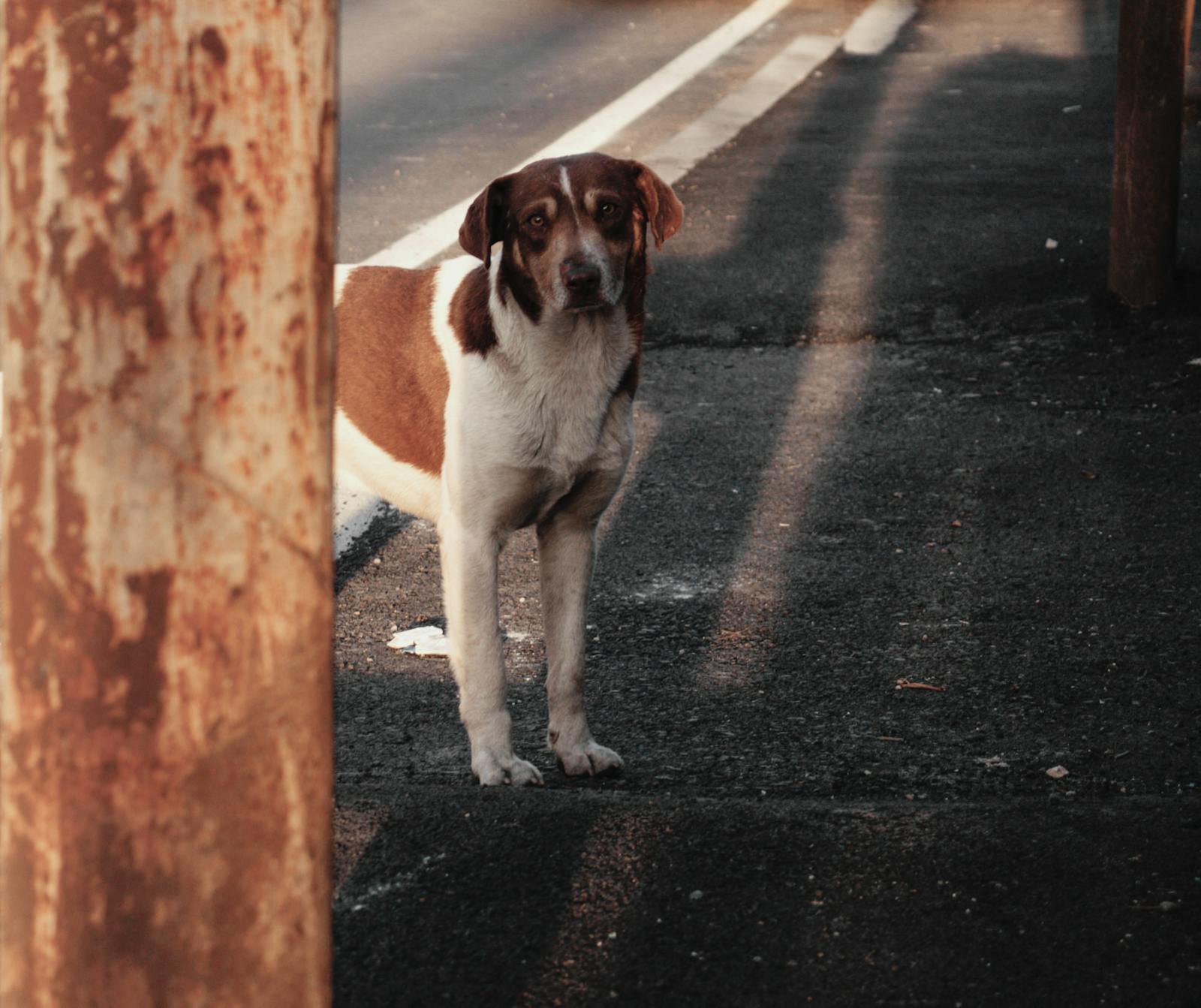
For seven weeks, the brindle by the seawall watched us from a doorway. This week, he didn't move when we set down the bowl. Here is what passive feeding looks like in slow motion — and why patience is the most underrated tool in animal welfare.
We call him "the brindle by the seawall." Not because we have any romantic attachment to nameless strays, but because he refused to give us any other signal. No tail wag. No glance over the shoulder. Just a quiet, patient watching from the safety of a half-open garage door.
For seven weeks, that was the entire interaction. We'd arrive, lay out two bowls of sawdust meat and rice, and back away. He'd wait until we were down the street before approaching, then eat with the same wary economy a marathoner uses for water at a station — fast, controlled, never looking up.
On Day 47 something shifted. We rounded the corner with our usual cooler and he was already at the curb. Not approaching us. Not retreating. Just standing in the open.
We didn't speak to him. Bel set the bowls down at the usual spot and we backed away to the truck. He walked over and started eating before we'd taken three steps.
That's it. That's the whole story. A dog ate a meal in front of us instead of hiding from us. To anyone outside this work it sounds underwhelming. To us it was the moment that justified every one of the forty-six trips before it.
This is what passive feeding does. It doesn't "win them over." It builds a slow, undeniable record in their nervous system: these humans show up, leave food, leave. Over seven weeks the brindle's brain rewrote our truck from THREAT to NEUTRAL. And once a stray's nervous system has you in the NEUTRAL column, trust becomes possible.
We don't know what comes next for him. Maybe one day a foster will say yes and he'll go indoors for the first time in his life. But the point of Phase 1 isn't to rush any of those things. The point is to make a stray's day a little less hungry and a little less afraid, today, exactly where they are.